Fingerprint Quality Standards for FBI Checks
Table of Contents
- Why Fingerprint Quality Standards Matter for FBI Checks
- Common FBI Fingerprint Rejection Reasons
- FBI FD-258 Fingerprint Card Instructions
- Live Scan vs Ink Fingerprinting for FBI
- How to Check Your Prints Before Submission
- What to Do If Your Fingerprints Were Rejected
- Getting FBI Checks Right the First Time
- Frequently Asked Questions
Last Updated: September 7, 2026
Why Fingerprint Quality Standards Matter for FBI Checks
Fingerprint quality standards for FBI checks determine whether your submission is accepted or returned, and a rejection can delay a job offer, immigration filing, professional licensing, or reporting for international visas by days or weeks. The FBI’s Next Generation Identification (NGI) system relies on automated algorithms that assess ridge detail, minutiae, and image clarity before a human examiner ever reviews them or even needs to review them.
Fingerprint quality standards are the technical thresholds the FBI applies to ensure captured fingerprints contain enough unique detail for accurate matching, governing image resolution, contrast, and fingerprint ridge classification details for either FD-258 fingerprint cards or for electronic live scan transmissions.
Common FBI Fingerprint Rejection Reasons
The FBI rejects submissions for recurring, preventable issues: insufficient ridge detail, smudged or overlapping fingerprints, fingerprints too light or dark, fingerprints incorrectly rolled in the wrong designated box on the fingerprint card grid, and missing or incorrect biographical data. A frequent culprit is the “ghost” effect, where a finger slides during rolling.
The FBI’s Image Quality Specifications, documented in the FBI’s Appendix F standards, set the minimum requirements for both ink and electronic submissions, aligning with the PIV-071006 standard for biometric data transmission.
Can fingerprints get rejected even if they look good?
The most common mistake is assuming that if the fingerprints are visible to you, they are acceptable to the FBI. The NGI algorithm evaluates the digital image at a pixel level. Fingerprints that look fine to the human eye can still fail the automated quality score because of insufficient contrast or missing minutiae. However, rejections are rare and don’t happen as often as you might think, especially when Dallas Live Scan Fingerprinting professionally rolls your fingerprints.
FBI FD-258 Fingerprint Card Instructions
Completing an FD-258 fingerprint card requires attention to both fingerprint blocks and biographical data fields, filled out in black ink with every field completed accurately before or after fingerprints are rolled.
FD-258 fingerprint card instructions begin with rolling each finger from nail edge to nail edge in a single, smooth motion, then taking plain impressions of four fingers on each hand and both thumbs at the bottom of the card, showing the complete pattern area from fingertip to the first joint crease.
| Submission Step | Common Error | Impact on Approval |
|---|---|---|
| Rolling technique | Partial roll, missing nail edge | Insufficient minutiae for matching |
| Ink application | Uneven or too heavy | Smudging, loss of ridge clarity |
| Data fields | Incorrect or missing info | Administrative rejection |
Professional technicians at Dallas Live Scan Fingerprinting avoid the rejection loop by checking each impression against the FBI’s quality threshold before the applicant leaves the chair.
Live Scan vs Ink Fingerprinting for FBI Background Checks
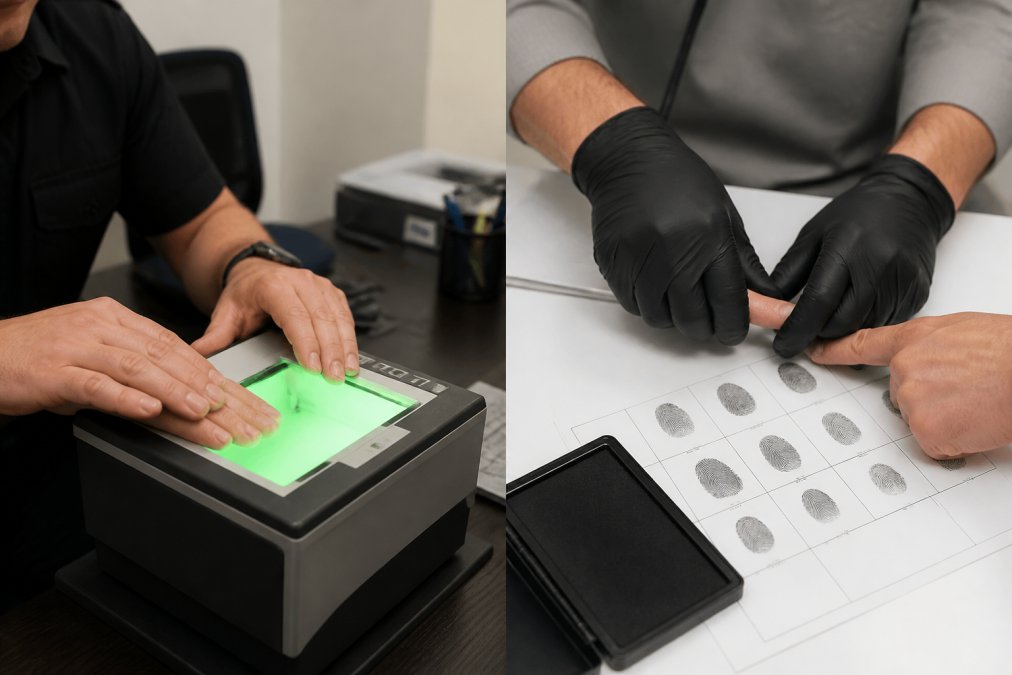
Dallas Live scan Fingerprinting captures fingerprints digitally and transmits them directly to an approved FBI Channeler, providing an immediate quality score so that any failing fingerprints are recaptured on the spot, unlike mailed ink fingerprint cards where problems can surface days later. The FBI’s electronic Biometric Transmission Specification (EBTS) governs how these digital files are formatted, and certified live scan devices and submission processes must meet these requirements to transmit directly to the NGI system. Dallas Live Scan Fingerprinting is an approved FBI live scan and ink fingerprinting vendor having captured and submitted thousands of fingerprint records successfully for the past two decades. We are truly the experts in the industry. This is not a hobby for us, it’s our full-time career.
Pro Tip
If you are a U.S. Citizen, or Legal Permanent Resident, Dallas Live Scan Fingerprinting can transmit your fingerprint record through an FBI-approved Channeler to receive your FBI Criminal History Identity Summary directly, which is what enables same-day results in most cases. This is the fastest path to a completed FBI background check. Call us today at 214-529-8157.
Ink-and-roll fingerprinting remains necessary when a particular state agency or when Immigration requires a physical fingerprint card; it’s quality depends almost entirely on the technician’s skill but at times, no matter how skillful a technician is, an applicant’s actual fingerprint quality may be too low to get a pass (very rare).
How to Check Your Fingerprints Before Submission
A good visual inspection can catch quality problems and so can good digital fingerprinting software. Dallas Live Scan Fingerprinting checks every applicant’s fingerprints during each appointment to see that ridge details appear distinct, there are continuous lines with clear spaces, and that fingerprint patterns are legible. Each fingerprint must contain sufficient minutiae points (ridge endings and bifurcations) and adequate resolution, measured in pixels per inch, to support the AFIS algorithm’s matching process.
A reputable vendor, such as Dallas Live Scan Fingerprinting, recaptures any fingerprint appearing to be below threshold.
Connect now for on-site service → 214-529-8157
Key Takeaway
Get it done right the first time with an expert in the field of fingerprinting to avoid time delays of inaccuracy or inexperience. We’ve had so many people over the years wishing they would have come to us first!
What to Do If Your Fingerprints Get Rejected
A rejection notice does not mean you are ineligible for a background check; it means the submission did not meet the FBI’s established requirements and must be resubmitted. The first step is to read the rejection letter carefully, as it will tell you whether the problem was image quality, missing data, or a technical formatting issue. The FBI’s rejection codes are standardized, and the FBI’s CJIS Division documentation explains what each code indicates.
If rejection was due to poor ridge detail or smudging, get a new capture. If administrative, such as the demographic or physical description fields were filled out incorrectly or incomplete, you will also be required to get a new capture to resubmit. Breaking the rejection loop requires a fresh capture with equipment and technique that meets the standard; switching from a self-service ink kit or self service digital kiosk to a professional live scan service, Like Dallas Live Scan Fingerprinting, to resolve the problem or eliminate potential issues in a single visit.
Getting FBI Checks Right the First Time
Meeting fingerprint quality standards for FBI checks comes down to three factors: proper finger preparation, correct capture technique, and immediate quality verification.
For applicants in the Dallas-Fort Worth area and beyond, Dallas Live Scan Fingerprinting provides both live scan and traditional ink-roll fingerprinting services with immediate quality verification during each appointment.
The cost of a rejection is the missed deadline, delayed start date, or extended wait for an Immigration decision. We always provide quality checks before submission to protect your timeline requirements.
Dallas Live Scan Fingerprinting combines FBI-approved Channeler submissions with the best live scan technology and mobile on-site service. When you need an FBI Identity Summary, our team verifies every fingerprint before it leaves our hands. Connect now at 214-529-8157 for an Irving office appointment or for on-site mobile service.
Frequently Asked Questions
What are the common reasons for FBI fingerprint rejection?
The FBI rejects fingerprints when they fail to meet quality thresholds for legibility and ridge detail. Common reasons include fingerprints that are too light or too dark, smudged or ghosted ridges, missing segments of the finger pattern, and scars or creases that obscure minutiae. Environmental factors like dry skin or excessive moisture also play a role. Ensuring your fingerprints meet the Appendix F image quality standards and skin care before prior submission is the best way to avoid rejection.
Should I use FD-258 or FD-1164 for my FBI check?
For most FBI criminal history background checks, the FD-258 standard fingerprint card is required and the most widely accepted card. The FD-1164 is typically used for non-criminal justice purposes, like some licensing or employment screenings, but even FD-258 cards still work for these purposes as well. The FBI’s Next Generation Identification (NGI) system uses the FD-258 format for civil submissions. If you are unsure which form your requesting agency needs, confirm with them first to prevent a submission delay.
Can I do my own fingerprints for an FBI background check?
No you cannot. Rejection rates are very high without proper training and most importantly, you need law enforcement or a certified fingerprint technician to verify your identity by means of current government issued identification that you are indeed the applicant getting fingerprints recorded for the background check. The FBI requires fingerprints that meet specific image quality standards, including clear ridge detail and correct spacing. Professionals use calibrated equipment and are trained to roll fingers evenly to capture all necessary minutiae. A rejection means your background check may get delayed. Using a professional service, such as Dallas Live Scan Fingerprinting, helps ensure your fingerprints are accepted the first time.
What is the difference between live scan and ink fingerprinting quality?
Live scan technology captures fingerprints digitally and provides an immediate quality score, allowing the technician to retake fingerprints on the spot if they do not meet quality standards. Ink-and-roll is a manual process where poor quality is often only discovered after submission, however, Dallas Live Scan Fingerprinting also conducts a close quality check of ink rolled fingerprints during the appointment. For FBI background checks, digital capture is preferred because it reduces errors and ensures compliance with Appendix F standards, leading to faster processing times.
Connect now for on-site service at 214-529-8157